Place guide
Very Large Array
Twenty-seven massive radio telescope dishes on the Plains of San Agustín used to image black holes and galaxies.
📍GPS: 34.075312, -107.619088
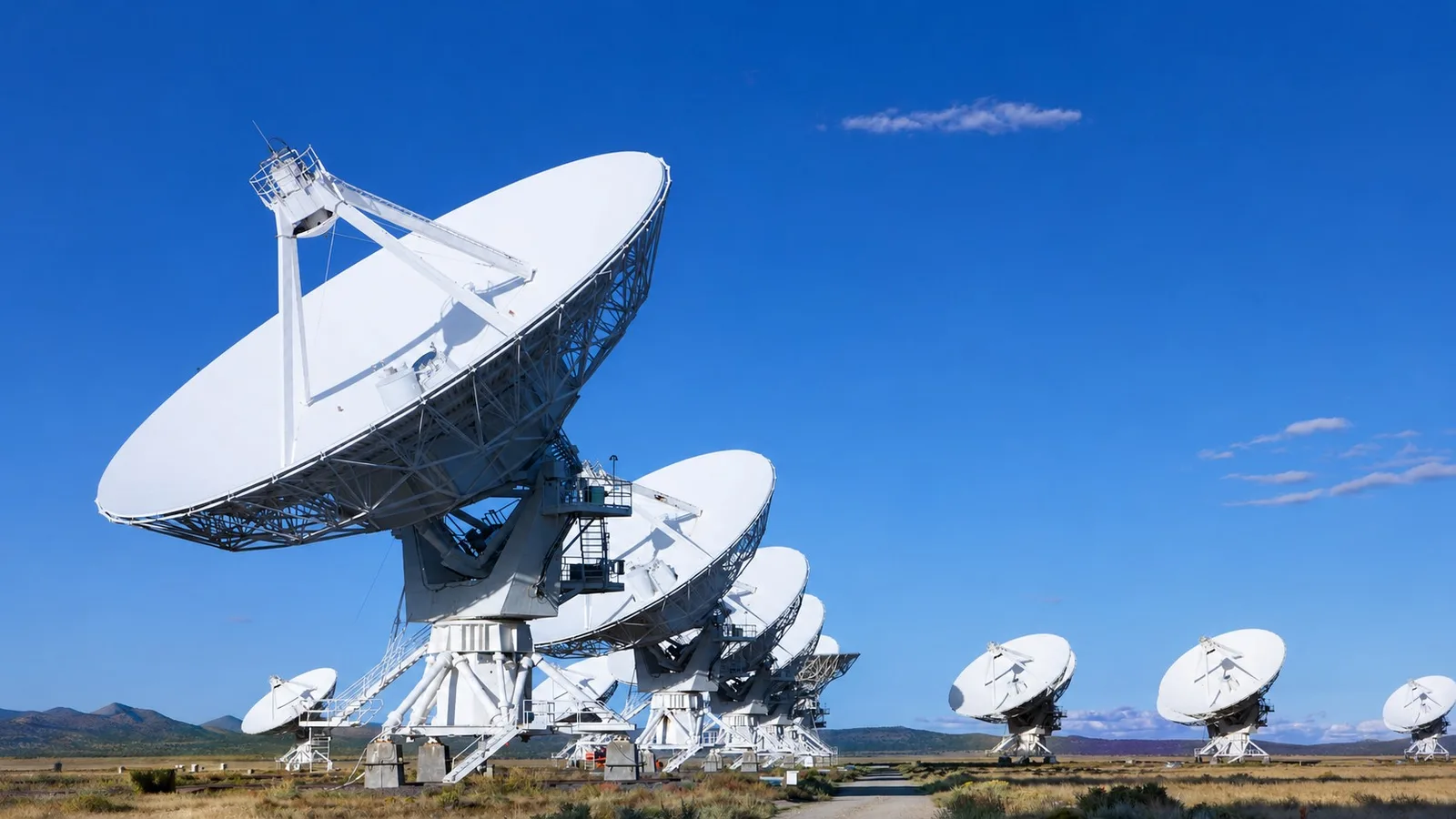
The Very Large Array (VLA) is one of New Mexico’s most recognizable landmarks: a collection of enormous white radio antennas spread across the remote Plains of San Agustin west of Socorro.
The 27 antennas work together as a single radio telescope, combining their observations to create incredibly detailed images of objects throughout the universe. Astronomers use the VLA to study everything from planets and newborn stars to supernova remnants, galaxies, and black holes.
The site is also open to visitors, making it one of the few places where you can walk right up to a world-class astronomical observatory.
What is the Very Large Array?
The VLA consists of 27 active radio antennas, each measuring 82 feet (25 meters) across. A 28th antenna is kept as a spare so individual dishes can undergo maintenance without shutting down the observatory.
The antennas sit along three railroad tracks extending outward from the center of the observatory in a giant Y shape. Unlike a traditional optical telescope, the VLA does not collect visible light. Instead, its antennas detect naturally occurring radio waves arriving from space. Signals from all 27 antennas are sent through fiber-optic cables to a powerful correlator that mathematically combines them into astronomical observations.
The dishes can also be physically moved along the railroad tracks. Spreading them farther apart allows astronomers to see finer details, somewhat like changing the zoom on a camera. At its widest configuration, the array behaves in some respects like a single radio telescope roughly 22 miles across.
History
Plans for the VLA emerged in the early 1960s, when astronomers sought a way to produce much sharper radio images of the universe. The remote Plains of San Agustin were chosen for their high elevation, dry climate, flat terrain, and isolation from radio interference.
Congress authorized construction in 1972, work began in 1974, and the VLA made its first observations with two antennas in 1976. By 1981, all 27 operating antennas and a 28th spare were complete.
A major modernization added new receivers, electronics, computing systems, and nearly 3,000 miles of fiber-optic cable. Completed in 2012, the upgraded facility was renamed the Karl G. Jansky Very Large Array and remains one of the world’s leading radio observatories.
Visiting the VLA
There is a small visitor center at the VLA with exhibits explaining radio astronomy and the science performed at the observatory, along with a documentary narrated by Jodie Foster. Outside, a self-guided walking tour leads through outside exhibits and directly to the base of one of the giant antennas.
Seeing the antennas from the highway gives you some sense of their size, but standing underneath one makes the scale much clearer. There is no food at the VLA, so bring food and water if needed.
Interesting Facts
-
It appeared in Contact. The VLA became closely associated with the search for extraterrestrial intelligence in popular culture after appearing prominently in the 1997 film Contact, based on Carl Sagan’s novel. Jodie Foster, who starred in the film, later narrated the documentary shown in the VLA Visitor Center.
-
The VLA is not primarily an alien-listening station. Despite its portrayal in movies and television, it is a general-purpose astronomical observatory used to investigate a huge range of phenomena across the universe.
-
The VLA is operated by the National Radio Astronomy Observatory. Its science operations are headquartered 50 miles away at the Pete V. Domenici Science Operations Center on the New Mexico Tech campus in Socorro.
-
The telescope has been used for thousands of research projects. More than 3,000 researchers have used the VLA for more than 11,000 observing projects, and research conducted with the array has contributed to more than 200 Ph.D. degrees.
Getting There
The VLA is located roughly 50 miles west of Socorro.
From Socorro, take US-60 west through Magdalena and continue toward the Plains of San Agustin. The final roads to the Visitor Center are paved. Because cellular service can be unreliable in the area, it is a good idea to load directions before leaving Socorro.
Nearby places
Datil Wells
Recreation area with camping, short trails, and remnants of the old Magdalena cattle-drive route.
Cibola National Forest
A diverse forest spanning the Sandia, Manzano, and Mount Taylor regions, offering cool mountain escapes from the desert.
Pie Town
A tiny high-desert community on the Continental Divide famous for its homemade pies.