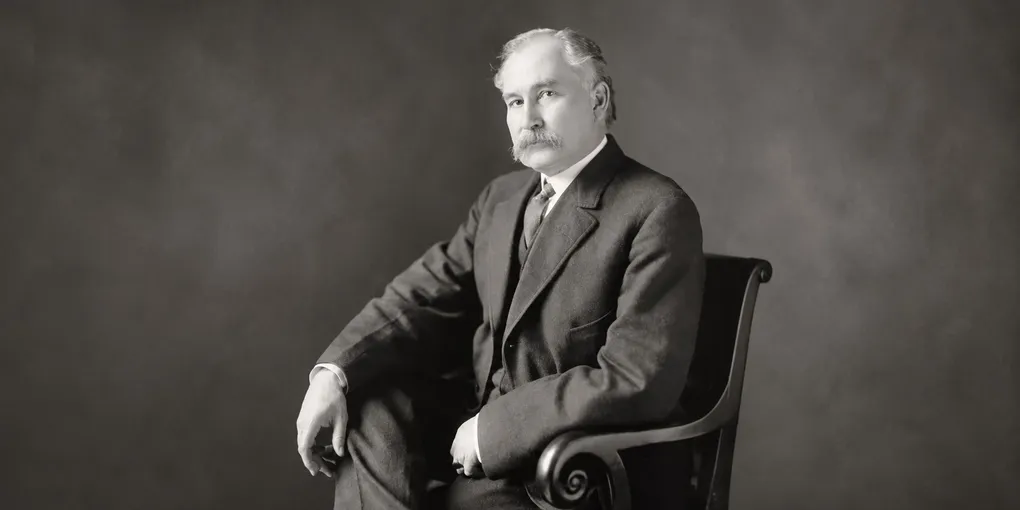
Who Was Albert B. Fall?
Albert B. Fall rose from the rough world of territorial New Mexico to become a United States senator and Secretary of the Interior. He would ultimately become one of the most infamous political figures of the early 20th century.
A lawyer, rancher, politician, and powerful advocate for western development, Fall represented New Mexico during its first years of statehood. His career collapsed after the Teapot Dome scandal, which exposed secret government oil leases, making Fall the first U.S. cabinet official convicted of a felony committed while in office.
Early Life in New Mexico
Albert Bacon Fall was born in Kentucky in 1861.
As a young man, he traveled through the American West and worked a variety of jobs before eventually settling in New Mexico. He studied law and was admitted to the New Mexico bar in 1891. Fall quickly became involved in territorial politics. During the following two decades, he served in several public positions, including the territorial legislature, as a judge, and as New Mexico’s attorney general.
At the same time, he developed extensive ranching interests in southern New Mexico. Fall established his home near Three Rivers in the Tularosa Basin. Over time, his ranching operation expanded dramatically. National Park Service histories estimate that his holdings eventually included more than one million acres of leased and privately owned land.
The enormous ranch connected Fall closely with the economic and political development of southern New Mexico.
One of New Mexico’s First Senators
When New Mexico became the 47th state in 1912, Fall became one of its first two United States senators alongside Thomas B. Catron.
Fall served in the Senate for nearly nine years. He developed a reputation as a strong advocate for mining, ranching, resource development, and the interests of the American West. He generally favored placing public lands and natural resources into productive private use rather than keeping large areas under federal control.
Fall also became friends with Senator Warren G. Harding of Ohio. When Harding won the presidency in 1920, he selected Fall to become his Secretary of the Interior, placing a New Mexican in charge of an enormous portion of the nation’s federal lands and natural resources.
It would prove to be the high point of Fall’s career.
The Teapot Dome Scandal
Soon after entering the Harding administration in 1921, Fall convinced the federal government to transfer control of several valuable naval petroleum reserves from the Navy Department to the Department of the Interior.
These oil fields had been set aside to ensure that the United States Navy would have access to petroleum during a national emergency. One of the reserves was located beneath the Teapot Dome rock formation in Wyoming.
Rather than opening the reserves to competitive bidding, Fall secretly arranged leases with private oil companies, including a company controlled by oil magnate Harry F. Sinclair. The agreements soon attracted attention. Newspapers began reporting on the secret leases in 1922, prompting the U.S. Senate to launch an investigation.
The investigation uncovered something even more suspicious: Fall had suddenly obtained large amounts of money from oil executives involved in the leases, including a controversial $100,000 payment described as a loan.
The question facing investigators was simple: Why did Albert Fall suddenly get so rich?
Fall Goes to Prison
The investigation grew into what became known as the Teapot Dome scandal, a defining political corruption scandal in early American history.
Years of congressional investigations and court cases followed. The federal government eventually regained control of the oil reserves, and Fall was prosecuted for accepting money connected with the deals. He was convicted and sentenced to ONE YEAR in prison.
The conviction secured Fall a notorious place in American history. He became the first U.S. cabinet official to be convicted of a felony and sent to prison. For decades afterward, “Teapot Dome” became shorthand for political corruption in Washington, much as Watergate would generations later.
Fall’s national political career was finished.
Fall and the Tularosa Basin
Fall’s influence in New Mexico extended beyond politics and ranching.
During his years in the Senate, he was also involved in some of the earliest proposals to protect the unusual landscapes surrounding the Tularosa Basin. Beginning in 1912, Fall supported proposals for a massive Mescalero National Park that would have encompassed portions of the Sacramento Mountains, Mescalero Apache lands, and eventually a small portion of the white gypsum dunes that later became White Sands National Park.
The proposal never became reality. The National Park Service has noted that Fall’s involvement was complicated by his enormous landholdings in the region, which potentially stood to become more valuable if a major national park was created nearby.
White Sands would eventually receive federal protection in 1933, long after Fall had left national politics.
Later Life
After his conviction and imprisonment, Fall largely disappeared from national political life.
Financial problems and declining health marked his later years. He eventually returned to his property near Three Rivers, New Mexico, where he had spent much of his life as a rancher. Fall’s original ranch headquarters was later demolished, but the Three Rivers Ranch itself continues to operate today, serving as a reminder of the vast ranching empire he once controlled.
Albert B. Fall died in 1944 at the age of 83.
Legacy
Albert B. Fall remains one of the most notorious political figures associated with New Mexico.
His career followed an extraordinary path from frontier lawyer and rancher to one of the state’s first U.S. senators and eventually a member of the president’s cabinet. But almost everything he accomplished was overshadowed by Teapot Dome. Hopefully future political leaders will learn from his mistakes and avoid the corruption that ultimately ended his career (lol, lmao even).