Place guide
Trinity Site
The remote White Sands location where the world's first atomic bomb was detonated on July 16, 1945.
📍GPS: 33.676469, -106.475781
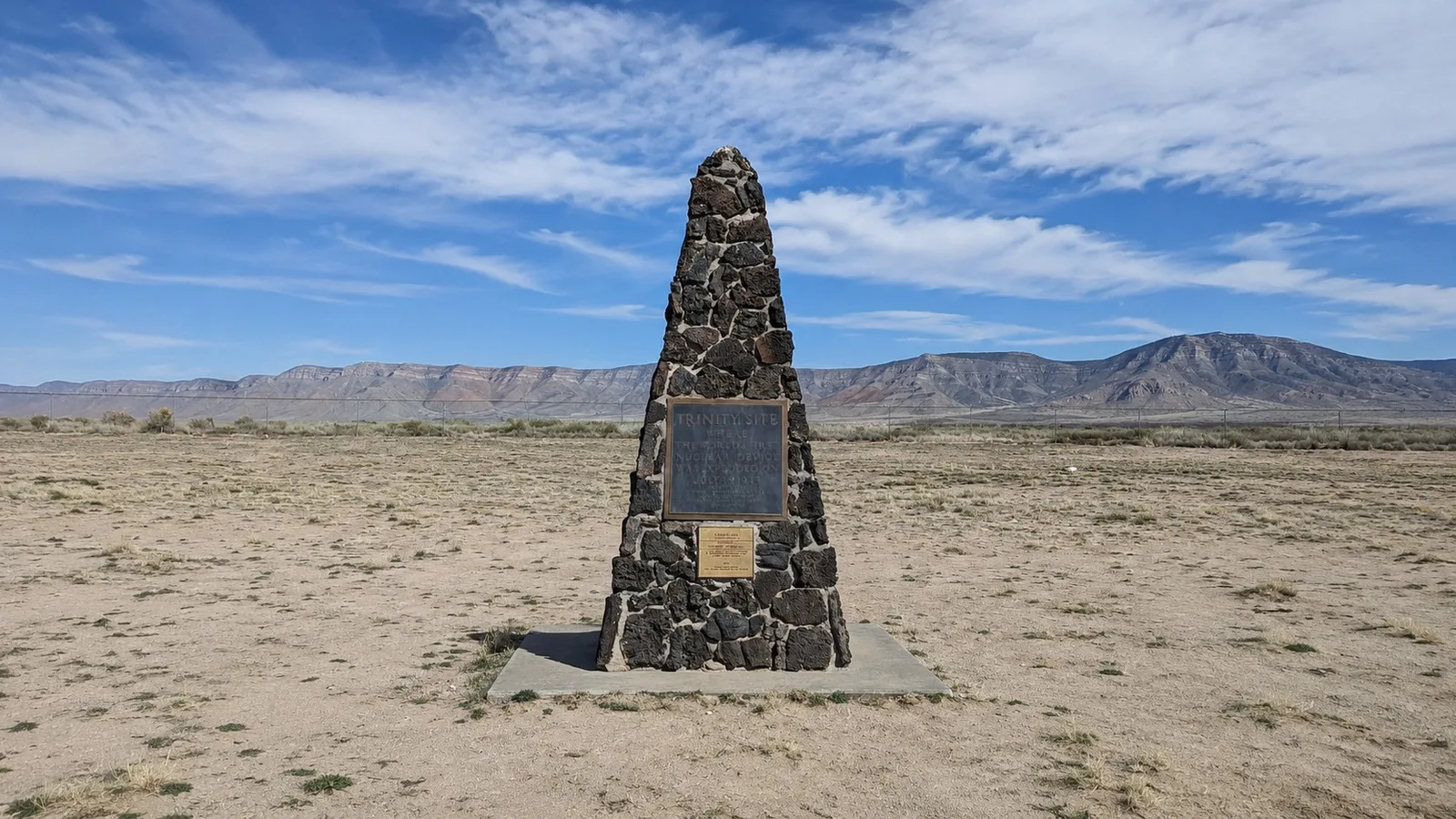
Trinity Site is one of the most historically significant—and hardest to visit—places in New Mexico. Located deep inside White Sands Missile Range, it marks the spot where the world’s first atomic bomb was detonated at 5:29 a.m. on July 16, 1945. Today, a simple stone obelisk stands at Ground Zero, surrounded by historic photographs and interpretive displays explaining the Trinity test, the Manhattan Project, and the people who worked at the site.
Visiting Trinity Site
Trinity Site is open to the public only one day each year, on the third Saturday in October. Admission is free, and there are no tickets or reservations to purchase. Stallion Gate is open from 8:00 a.m. to 2:00 p.m., and Trinity Site closes promptly at 3:30 p.m. Arrive as early as you reasonably can. You can expect there to already be a long line of vehicles waiting to enter at 8:00 a.m.
Getting There
Do not simply type “Trinity Site” into your GPS and follow it blindly. All visitors must enter through Stallion Gate, reached from Highway 380 between San Antonio and Carrizozo. The turnoff is approximately 12 miles east of San Antonio and 53 miles west of Carrizozo. From Highway 380, follow New Mexico Highway 525 south for about five miles to the gate.
Once through the gate, Trinity Site is still about 17 miles away. The road across the range is paved, well marked, and suitable for normal passenger vehicles. RVs, campers, buses, and motorcycles are also permitted, although motorcycle riders must wear a helmet and reflective gear. There is no gas station on the missile range, so arrive with a full tank.
What You Need to Enter
Everyone age 18 or older must bring a government-issued photo ID. Drivers should also carry the vehicle’s registration and proof of insurance, or the rental agreement for a rental vehicle. Foreign nationals must present a valid passport. No weapons or firearms are allowed, and there is nowhere at the gate to store them. Marijuana is also prohibited because the site is on a federal military base.
Ground Zero
From the parking area, visitors walk across the sand to the fenced Ground Zero area. At the center stands a lava-rock obelisk marking the location of the 100-foot steel tower that held the bomb. Historic photographs and information panels line the fence, helping visitors understand what the empty desert looked like before, during, and after the explosion.
You can also see Jumbo, a massive steel container originally built in case the bomb’s conventional explosives detonated without beginning a nuclear chain reaction. It was ultimately not used for that purpose and survived the Trinity blast from a distance.
McDonald Ranch House
A free shuttle covers two miles from Ground Zero to the Schmidt/McDonald Ranch House. Scientists used a room inside the house to assemble the bomb’s plutonium core before it was transported to the tower. The restored adobe house contains historic photographs, exhibits, and information about both the Manhattan Project and the ranching family that lived there before the military took control of the area. The building has been restored to resemble its appearance during the final preparations for the test.
Is Trinity Site Worth Visiting?
Trinity Site is absolutely worth seeing if you can time it right. The physical site is sparse, but standing at Ground Zero and visiting the room where the plutonium core was assembled gives the history a scale that photographs cannot. The major challenge is access. You get one opportunity each year, crowds can be substantial, and reaching the site requires an early start and a long drive. Also, bring cash in case you want to purchase food or souvenirs. Good luck!
Nearby places
Jornada Lava Field
A vast lava field in southern New Mexico, offering unique geological formations and a rugged desert landscape.
Bosque del Apache National Wildlife Refuge
New Mexico's most famous wildlife refuge, known for wintering sandhill cranes, snow geese, wetlands, and dramatic sunrise fly-outs.
Socorro
A small city on the Rio Grande known for birdwatching, mining, and science.