Place guide
Scientology Trementina Vault
A remote facility where Scientology's teachings are stored in an underground bunker, marked by crop circles visible from the air.
📍GPS: 35.523806, -104.569694
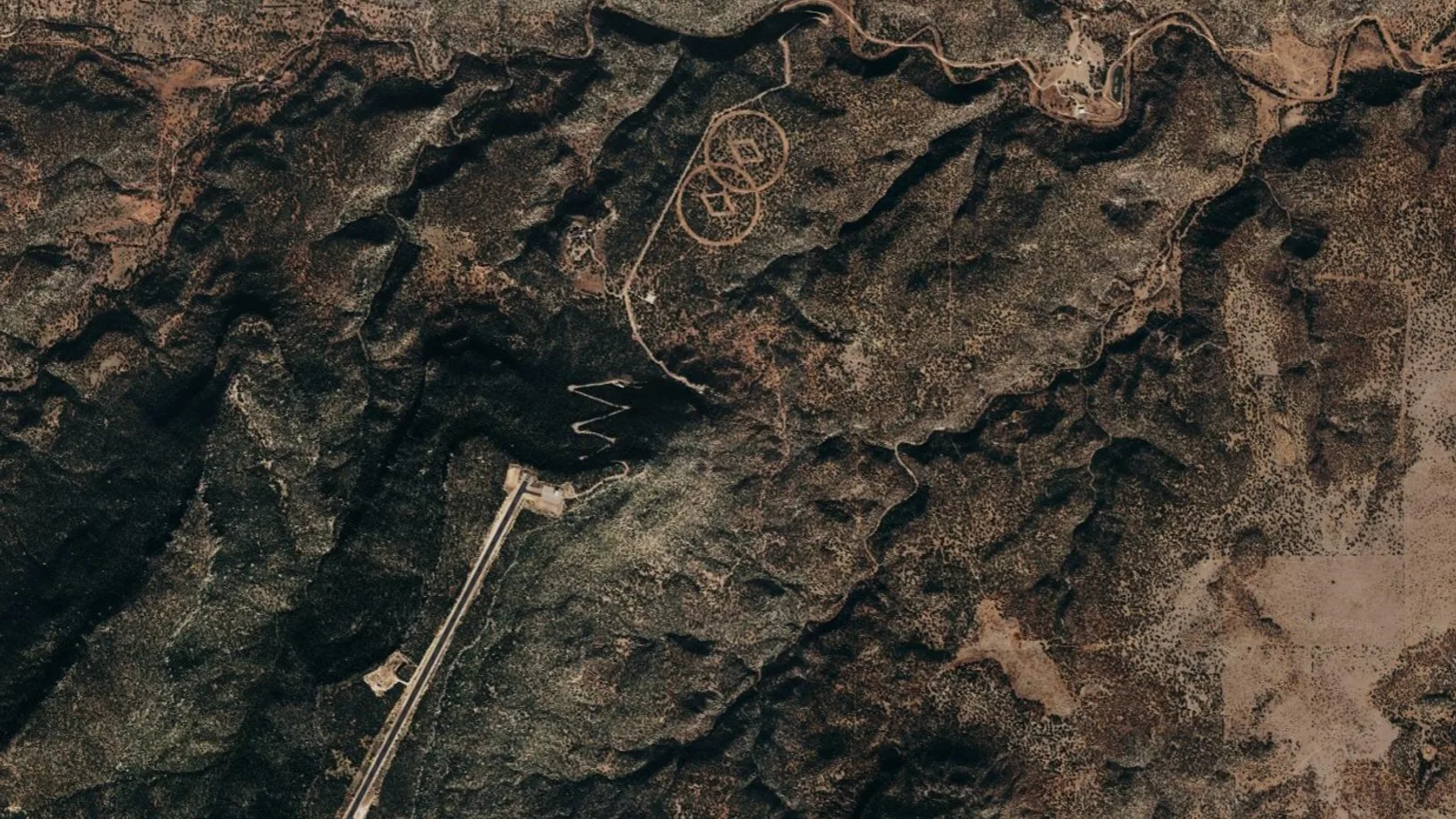
Hidden in the desert east of Las Vegas, New Mexico, is possibly the strangest religious archive in the United States: an underground Scientology vault, protected by guards and massive doors, accompanied by a private airstrip, and marked by enormous symbols carved into the ground.
Usually called Trementina Base, the compound belongs to the Church of Spiritual Technology (CST), a Scientology organization whose job is to preserve the writings and recorded lectures of Scientology founder L. Ron Hubbard for the distant future.
What Is Trementina Base?
Trementina Base sits in a remote part of San Miguel County near the tiny community of Trementina, roughly 40 miles east of Las Vegas.
Construction began in the 1980s as part of an enormous preservation project undertaken by the Church of Spiritual Technology. CST says its purpose is to ensure that Hubbard’s original writings and lectures survive intact for future generations, even if ordinary books, recordings, and digital media eventually disappear.
That preservation effort is considerably more elaborate than putting books in a climate-controlled room.
According to Scientology itself, CST has preserved Hubbard’s works using more than 135 tons of archival books, stainless-steel plates, and nickel-plated records, which are stored across the country in approximately 2,300 titanium capsules inside what are described as “calamity-proof” vaults.
The idea is that even centuries or millennia from now, future readers could recover Hubbard’s teachings without depending on computers, modern file formats, magnetic tape, or ordinary paper.
Inside the Underground Vault
Trementina’s archive was excavated directly into the rock.
Reports described the facility as a pair of 350-foot tunnels arranged in a V shape, with gigantic nuclear-blast-resistant doors designed to remain usable for as long as 1,000 years. The Center for Land Use Interpretation reports that the main doors weigh about 6,000 pounds.
When ABC’s 20/20 was allowed inside the archive in 1998, the program showed thousands of metal records stored in heat-resistant titanium containers. The system even included a solar-powered record player, allowing the recordings to theoretically be played in a future where the electrical grid and modern electronics no longer existed.
Former CST worker Dylan Gill described the interior as a long, white-painted concrete passage with another secure door farther inside. He said the vault contained playback equipment and instructions intended to make the archive usable even by people unfamiliar with the technology.
Giant Petroglyphs
The feature that made the vault famous is not actually underground.
Above the vault are two enormous overlapping circles containing diamond shapes, etched into the landscape and clearly visible in aerial and satellite imagery. They reproduce the logo of the Church of Spiritual Technology and are sometimes described online as an “alien landing marker”.
A more interesting explanation comes from former Scientologists. Several have claimed the markings are intended as a return point that would allow Scientologists—or Hubbard himself—to locate the preserved teachings in a future incarnation. Former CST worker Dylan Gill specifically said he understood the symbol as a marker to help Hubbard find the site after 4 taking another body. Whatever the purpose, the symbols are there to draw attention to the vault site.
A Private Airstrip
Trementina Base also has something unexpected for a religious archive: its own airport.
San Miguel Ranch Airport (NM53) sits beside the compound and has a paved asphalt runway large enough to accommodate substantial private aircraft. It is privately owned, has no control tower or published instrument approaches, and FAA-derived airport information contains an unusual remark: “OWNER DESIRES ARPT NOT BE CHARTED.” Requesting that a private airport not be charted is not unheard of for private airstrips. Having large untracked jets land at the property does contribute to the strangeness of the site however.
More Than Just a Bunker
The complex is larger than just archives.
San Miguel County officials who toured the property in 2005 reported seeing a dormitory, cafeteria space, meeting rooms, livestock facilities, a generator, the airstrip, and the archival center itself. Former CST employees have also mentioned an “LRH House” at Trementina, a house maintained for Hubbard’s eventual return in a new body.
Former employee Dylan Gill said CST workers were taught that, after Hubbard returned and was reborn,
he could come to one of these sites and be housed and cared for there.
Gill described the LRH House as a place where a reincarnated Hubbard could be raised until he was old
enough to resume leadership.
The property is really a self-contained remote dooms-day survival compound more than a conventional library.
Why Preserve L. Ron Hubbard’s Work Like This?
To Scientologists, Hubbard’s writings are not simply historical documents.
Scientology teaches that its religious “technology” must be reproduced and practiced exactly as Hubbard intended. CST was formed in 1982 specifically to preserve those works so future generations would have what Scientology describes as the complete and unaltered original scriptures. That helps explain the extraordinary amount of effort devoted to materials that could have simply been digitized. That’s the goal of Trementina: build an archive that could outlive the civilization that created it.
Can You Visit Trementina Base?
No. Trementina Base is private property and is not a tourist attraction.
The compound is gated and access is restricted. There is little reason to drive to the property itself, since the underground vault cannot be seen from a public road and entering the property without permission would be trespassing.
For travelers, Trementina is best thought of as one of New Mexico’s great modern mysteries: a real underground archive hidden beneath the desert, built to preserve the words of L. Ron Hubbard for all time.
Nearby places
Conchas Lake State Park
A large reservoir on the Canadian River popular for boating, water skiing, and camping.
Las Vegas National Wildlife Refuge
A prairie wetland refuge near Las Vegas, NM with sweeping grassland views, migratory birds, hiking, photography, and wildlife watching.
Las Vegas
A beautifully preserved Victorian-era town with over 900 historic buildings on the Santa Fe Trail.